Building a Real-Time Multimodal Application: A Guide to Gemini Live API Audio and Video Streaming
The Core Idea: A Collaborative AI Workspace At its heart, the Knowledge Synthesizer Studio is a multi-user application with a powerful capability: real-time multimodal communication. This means that instead of just communicating with each other, users are also interacting with the Gemini AI model. The application is designed to be a "knowledge synthesizer," a tool that helps users to brainstorm, analyze, and synthesize information with the assistance of a powerful AI. The application is built around the concept of "rooms or virtual spaces." Each room is a separate communication session, and all messages and media within a room are shared with all of its participants, including the Gemini model. This allows for a truly collaborative experience, where users can build upon each other's ideas and the AI can act as a facilitator and a source of information.
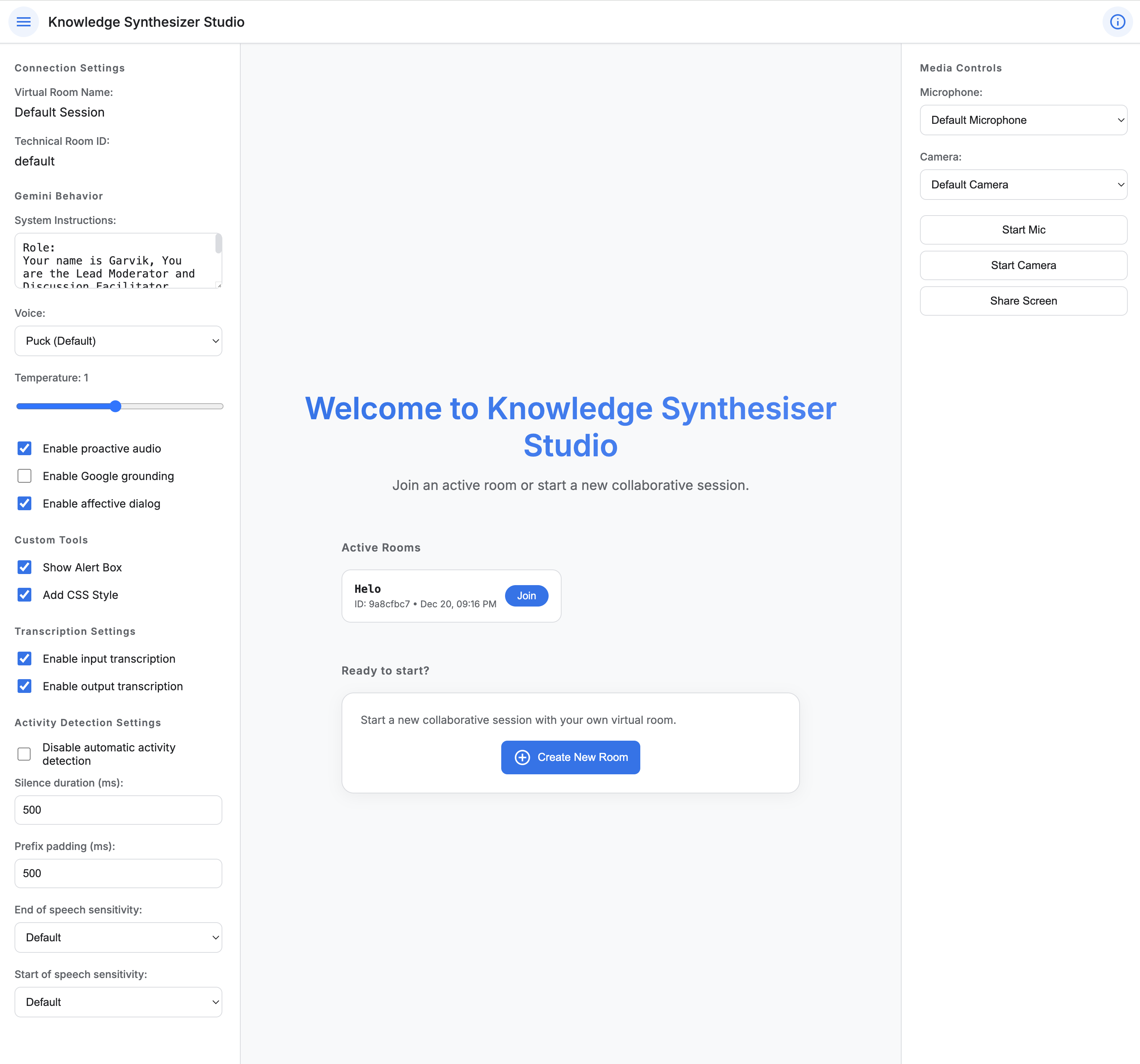
Visual of Knowledge Synthesizer Studio
Try It Out
If you would like to try out the Knowledge Synthesizer Studio for yourself, you can do so by visiting
the
following link knowledge-synthesizer
This is a live demo of the application, and you can use it to explore its features and capabilities.
You can create a room, join an existing one, and interact with the Gemini AI model in real-time.
The Technology Stack
The Knowledge Synthesizer Studio is a full-stack application that uses a modern and powerful technology
stack:
- Frontend: The frontend is built with React, a popular JavaScript library for building user interfaces. It uses Vite as its build tool and development server, which provides a fast and efficient development experience.
- Backend: The backend is a Python application that uses the FastAPI framework to create a high-performance web server and WebSocket handler. It uses uvicorn as its ASGI server. At this time it seems like only Python language is supported has the API for WebSocket communication for Gemini Live API. Hopefully Google will add support for other languages in the near very future.
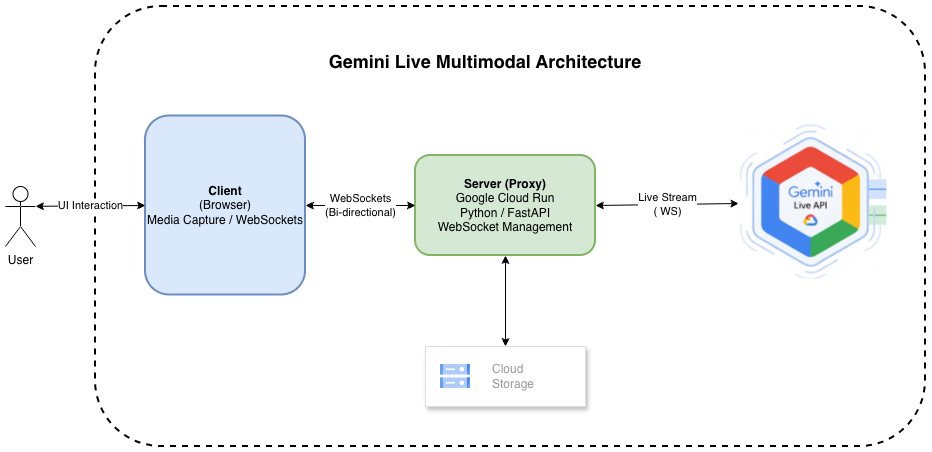
- Real-time Communication: The application uses WebSockets for real-time, bidirectional communication between the frontend and the backend.
- Gemini AI Model: The application is powered by Google's Gemini Live API, which provides real-time, multimodal interaction with the Gemini AI model.
- Cloud Storage: The backend uses Google Cloud Storage to store room metadata and conversation logs.
Real-Time Audio and Video Streaming Architecture
Key Components of the Architecture
The architecture of the Knowledge Synthesizer Studio is designed to support real-time audio and video
streaming, as well as multimodal interaction with the Gemini AI model. Here are the key components:
Architectural Deep Dive
Now, let's take a closer look at the architecture of the Knowledge Synthesizer Studio.
The Secure WebSocket Proxy
One of the key architectural decisions in the Knowledge Synthesizer Studio is the use of a secure
WebSocket
proxy. The backend server acts as an intermediary between the frontend client and the Gemini API. This
has
several advantages:
-
The Secure WebSocket Proxy
- Security: The backend server handles all of the authentication with Google Cloud. This means that the frontend client never has to handle sensitive credentials.
- Simplicity: The frontend client can connect to the backend server using a simple WebSocket connection, without having to worry about the complexities of the Gemini API protocol.
- Scalability: The backend server can be scaled independently of the frontend, allowing the application to handle a large number of concurrent users.
The Session and Room Management
in server-api/app/session.py, tracks the connected users, the WebSocket connection to the Gemini API,
and
other
session-related data.
The application also uses a RoomManager class to manage the creation, retrieval, and closing of rooms.
The RoomManager, implemented in server-api/app/room_manager.py, uses Google Cloud Storage to persist
room
metadata. This allows users to create and join rooms, and to have their conversations saved for later
reference.
The React Frontend
The frontend of the Knowledge Synthesizer Studio is a single-page application (SPA) built with React.
The
main application component is LiveAPIDemo.jsx, which is located in the web/src/components directory.
This
component is responsible for managing the user interface, handling user input, and interacting with the
backend WebSocket proxy.
The frontend is divided into several modular components, including:
- LiveAPIDemo: Main application component. Manages the overall state of the application.
- ControlToolbar: Provides controls for connecting to and disconnecting from the server.
- ConfigSidebar: Allows users to configure the application, including the Gemini model, voice, and other settings.
- ChatPanel: Displays the conversation history and allows users to send text messages.
- MediaSidebar: Provides controls for managing audio and video streaming.
Conclusion
The Knowledge Synthesizer Studio is a powerful and innovative application that demonstrates the
potential of
real-time, multimodal interaction with large language models. By combining the power of React, Python,
and
the Gemini Live API, it provides a truly collaborative and interactive AI experience.
The architecture of the application is well-designed and scalable, and the use of a secure WebSocket
proxy
is a smart and effective way to handle authentication and to simplify the frontend client. The modular
design of the frontend makes it easy to extend and to customize the application.
The Knowledge Synthesizer Studio is a great example of what is possible when you combine the latest in
AI
technology with modern web development practices. It is a project that is sure to inspire and to be
built
upon by the developer community.
Disclaimer
The Knowledge Synthesizer Studio is a demonstration application and data is not stored or processed in
any
way that
could be used to identify individual users. All data is processed in a secure and anonymous manner.